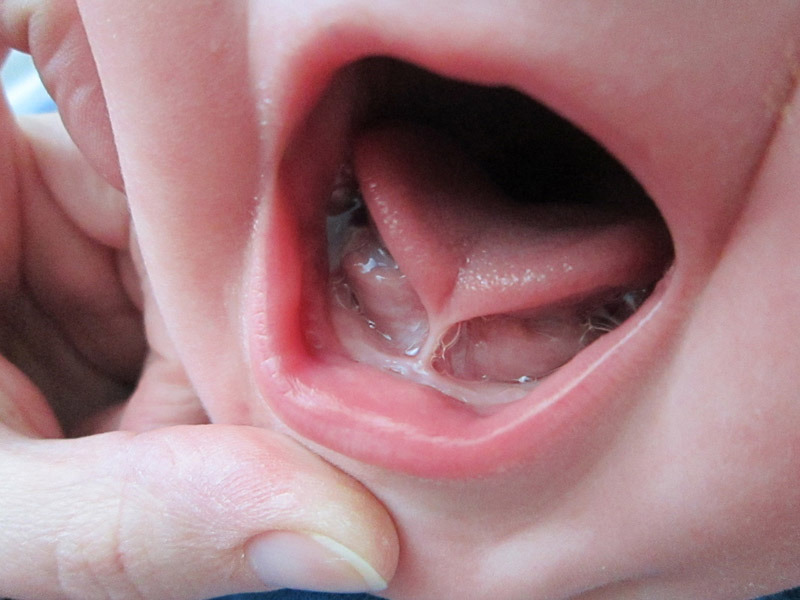
A parent searching “does my child need a tongue tie evaluation” is usually reacting to something real: a baby struggling at the breast, a toddler whose speech sounds unclear, or a comment from a well-meaning provider. The concern is valid, but the path from concern to treatment is not always straightforward. At Miles of Little Smiles, we believe that honest guidance begins with helping families understand when a concern about a lip tie vs tongue tie in a child actually calls for clinical action and when watchful patience is the better path.

Why Hearing the Word “Tie” Early Does Not Answer the Treatment Question
Many newborns receive an informal observation about a possible tongue or lip tie within days of birth. That observation, on its own, does not tell you whether your child will experience feeding difficulty, speech delay, or restricted oral movement. A tie is an anatomical variation, and anatomy alone does not predict function. Some children with visible ties feed, speak, and grow without any difficulty at all.
Appearance Alone Is a Weak Reason to Act. Function Is the Stronger Reason
A short or thick lingual frenulum may look restrictive without actually limiting how the tongue moves during feeding or speech. The same is true for an upper lip frenulum that appears tight. What matters more than how the tissue looks is what the child can and cannot do because of it. The table below outlines the difference between appearance-based concerns and function-based concerns.
| Factor | Weak Indicator for Treatment | Stronger Indicator for Treatment |
| Frenulum appearance | Tissue looks short or thick | Tissue visibly restricts tongue elevation or lateral movement |
| Feeding | Mild fussiness during nursing | Persistent poor latch, low weight gain, maternal pain despite lactation support |
| Speech | Slight lisp at age 2 | Ongoing articulation errors (L, R, T, D, S sounds) past age 4 despite therapy |
| Oral hygiene | Lip tie present | Tie traps food or prevents proper brushing of the upper front teeth |
>>> Read more: https://www.healthychildren.org/English/news/Pages/AAP-report-addresses-rise-in-tongue-tie-diagnoses-for-breastfeeding-concerns.aspx
What Counts as a Meaningful Functional Issue in Infants, Toddlers, and Older Children
The signs that suggest a tongue tie or lip tie is actually interfering with daily function vary by age group.

Infants (0 to 12 months)
- Inability to maintain a deep latch during breastfeeding
- Clicking sounds or frequent loss of suction while nursing
- Slow weight gain that lactation support has not resolved
- Maternal nipple pain or damage that persists beyond the first weeks
Toddlers (1 to 3 years)
- Difficulty transitioning to solid textures or frequent gagging on age-appropriate foods
- Open-mouth resting posture that does not improve
- Tongue shape that consistently appears heart-shaped when the child cries or attempts to lift the tongue
Children 4 and older
- Speech problems related to tongue tie in kids, particularly with sounds that require tongue elevation (L, R, T, D, N)
- Difficulty licking lips, clearing food from teeth, or playing a wind instrument
- Recurring cavities along the upper front teeth linked to a restrictive lip frenulum
When Latch, Speech, Hygiene, or Oral Mobility Concerns Deserve a Closer Look
Not every symptom listed above automatically means a release procedure is needed. A closer look is warranted when:
- Feeding challenges have persisted despite working with a lactation consultant
- A speech-language pathologist has identified restricted tongue movement as a contributing factor
- Oral hygiene is consistently compromised because the frenulum prevents access to certain teeth
- The child reports discomfort or avoids certain foods and oral activities
If two or more of these circumstances apply, scheduling a pediatric dental evaluation is a reasonable next step. The goal of that visit is not to confirm that a procedure is needed but to determine whether the anatomy is contributing to the functional problem your child is experiencing.

Why a Pediatric Dentist May Want Other Professionals Involved Before Deciding
A responsible evaluation for tongue tie feeding issues in a child often involves more than one provider. At Miles of Little Smiles, our approach to a frenectomy in White Plains starts with understanding what other professionals have already observed.
- Lactation consultants can confirm whether latch problems are tied to anatomy or positioning
- Speech-language pathologists can determine whether articulation errors stem from restricted movement or developmental timing
- Myofunctional therapists can assess oral resting posture, swallowing patterns, and muscle coordination
- Pediatricians or ENTs can rule out airway or structural issues that mimic tie-related symptoms
This team-based perspective protects families from unnecessary procedures and gives the dentist a clearer clinical picture.
>>> Read more: https://milesoflittlesmiles.com/benefits-of-laser-frenectomy-for-a-child/

What a Release Is Meant to Improve — and What It May Not Solve on Its Own
A frenectomy is a minor procedure that removes or modifies restrictive tissue to increase the range of motion of the tongue or lip. When the right conditions are present, it can meaningfully improve latch, tongue mobility, and access for oral hygiene. The procedure itself is quick, but its success depends heavily on whether the underlying problem was truly caused by the restriction.
However, a release alone does not:
- Teach the tongue new movement patterns after years of compensation
- Automatically correct speech sound errors without follow-up therapy
- Guarantee that feeding will improve if other causes are contributing
>>> Read more: https://leader.pubs.asha.org/do/10.1044/2024-0731-slp-aap-ankyloglossia/full/
Post-procedure exercises or therapy sessions are often part of the recovery plan, especially for older children whose muscles have adapted to the restriction. Families should plan for this follow-up care when considering the full scope of treatment.
When Monitoring Is More Reasonable Than Rushing into Treatment
Some ties are best watched over time rather than treated immediately. Monitoring may be the more reasonable approach when:
- The child is feeding well and gaining weight appropriately
- Speech is still developing, and the child has not yet reached the age where certain sounds are expected
- The frenulum appears restrictive, but is not currently causing functional problems
- A qualified therapist has not yet assessed the child
A tongue tie dentist in White Plains who prioritizes function over appearance will recommend observation in these situations and schedule follow-up visits to track any changes. Revisiting the concern at regular intervals allows your provider to catch any emerging functional limitations without committing to a procedure that may never be needed.

Questions Parents Should Ask Before Agreeing to a Procedure
Before moving forward, parents should feel confident that the decision is grounded in function, not fear. Consider asking:
- What specific functional limitation does my child have because of this tie?
- Have other providers (lactation, speech, myofunctional therapy) been consulted?
- What outcomes should we expect from the release, and how soon?
- What happens if we wait three to six months instead?
- Will my child need therapy or exercises after the procedure?
- What type of frenectomy do you perform, and why is that method appropriate here?
These questions help ensure that treatment is proportional to the problem. A provider who welcomes these questions is one who values informed consent and shared decision-making.
Schedule a Pediatric Frenectomy Evaluation at Miles of Little Smiles
If feeding, speech, or oral movement concerns are affecting your child’s daily function, a pediatric frenectomy evaluation can help you understand what is happening and what options make sense. Whether your child’s tie needs monitoring, collaboration with other providers, or treatment now, our team in White Plains will walk you through the decision with honesty and clinical care. We are here to give you clarity, not pressure.
Request a consultation to start the conversation about what your child actually needs.
