Answer Snapshot:
The best pediatric dentist for your child is not simply the closest office. Westchester parents should look for pediatric-specific training, board certification, child-centered communication, prevention planning, emergency readiness, and experience with infants, teens, anxious children, and patients with special health care needs.
Choosing a dentist for your child can feel more personal than choosing a provider for yourself. You are not only asking someone to check teeth. You are choosing the team your child may remember every time they think about dental care. A calm, well-planned first experience can make future cleanings, emergency visits, and treatment conversations much easier.
For families in White Plains, Scarsdale, Harrison, Purchase, Rye Brook, Hartsdale, Elmsford, and nearby Westchester communities, the search often starts with phrases like pediatric dentist near me or kids dentist in White Plains. That is a reasonable starting point, but it is not enough. The right pediatric dental home should match your child’s age, personality, health history, anxiety level, cavity risk, and family logistics.
Quick comparison checklist for parents
| What to check | Why it matters | Question to ask |
| Pediatric specialty training | Children have different dental development, behavior needs, cavity patterns, and growth considerations than adults. | Did the dentist complete pediatric specialty training after dental school? |
| Board certification | Board certification is a strong professional trust signal, especially for parents comparing providers. | Are the dentists board-certified pediatric dentists? |
| Infant-to-teen experience | A toddler visit, a teen sports injury, and a special needs visit require different communication and planning. | What ages and needs does the office commonly treat? |
| Prevention-first approach | Good pediatric dentistry should help families reduce risk, not only repair problems after they appear. | Will we receive home-care, diet, fluoride, sealant, and cavity-risk guidance? |
| Emergency readiness | Parents need clear next steps during pain, swelling, tooth injury, or a knocked-out tooth. | Do you offer same-day emergency guidance or emergency appointments? |
| Child-centered communication | Children respond better when the team explains steps in a predictable, non-threatening way. | How do you support nervous or sensory-sensitive children? |
1. Start with pediatric-specific training, not just convenience
A pediatric dentist is trained to care for infants, children, adolescents, and children with special health care needs. This matters because baby teeth, early permanent teeth, jaw growth, oral habits, dental anxiety, and parent coaching all require a child-centered approach.
When comparing offices, look for whether the dentists completed pediatric dental residency training, whether they are board-certified, and whether the practice explains the doctors’ background clearly. Miles of Little Smiles has a strong E-E-A-T foundation here because the doctors page presents board-certified pediatric dentists and specific pediatric training history. That information should be used more visibly in blog introductions, author/reviewer blocks, and local service content.
2. Look for a true dental home, not a one-time cleaning location
A dental home means your child has a consistent place for prevention, growth monitoring, emergency questions, and treatment planning. For young children, this is especially valuable because parents often need practical advice about brushing battles, toothpaste amount, pacifier use, thumb habits, snacks, teething, and what to do when a tooth changes color after a fall.
A strong pediatric dental office should not make every visit feel like a sales decision. It should help parents understand what is healthy, what needs monitoring, what needs treatment, and what choices exist. This is one of the most important differences between an average local page and a high-converting local SEO article: the article should help the parent make a decision before they call.
3. Evaluate how the office handles fear, sensory needs, and behavior
Many children are nervous at the dentist. Some are shy, highly active, sensory-sensitive, medically complex, autistic, or recovering from a previous difficult appointment. A pediatric dentist should be ready to adapt the visit, pace, language, and behavior guidance to the child in front of them.
Good signs include child-friendly explanations, tell-show-do communication, positive reinforcement, short breaks when needed, caregiver collaboration, and a willingness to discuss sedation only when it is appropriate for the child and the procedure. Avoid language that promises a visit will always be pain-free or stress-free. A better promise is that the team will plan thoughtfully, explain clearly, and choose the safest reasonable approach for the child.
4. Make prevention the center of the conversation
A parent should leave the office understanding more than whether cavities are present today. They should understand their child’s cavity risk, brushing routine, fluoride exposure, diet patterns, spacing/crowding concerns, sealant timing, and what to watch for before the next visit.
- Ask whether the dentist explains cavity risk instead of only counting cavities.
- Ask whether fluoride varnish, sealants, or silver diamine fluoride may be appropriate for your child’s age and risk.
- Ask how the office teaches brushing and flossing in a way that is realistic for a busy family.
- Ask whether your child’s checkup schedule should be personalized based on risk rather than treated as one-size-fits-all.
5. Review emergency guidance before an emergency happens
A dental emergency is not the moment parents want to start searching Google. A local pediatric dentist should make it easy to understand what counts as urgent, when to call, what to do for a toothache, how to handle a broken tooth, and how to respond if a permanent tooth is knocked out.
Miles of Little Smiles already has an emergency dentistry page and a phone number visible on the site. The content opportunity is to strengthen this with parent-friendly decision articles that answer the first 10 minutes of an emergency: what to do, what not to do, when to seek medical care, and when to contact the pediatric dentist.
6. Check whether the office experience is built around children
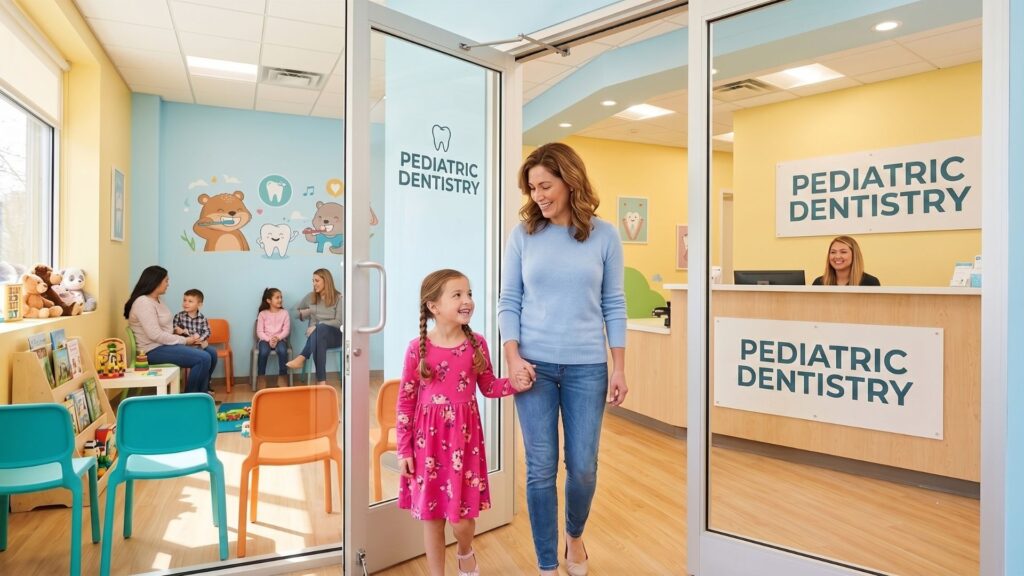
A child-friendly office is not only decor. It is the full experience: the tone of the front desk, the way the team speaks to children, the pacing of the appointment, the cleanliness and organization of the space, the way instruments are introduced, and how parents are included in decisions.
Before booking, parents can look at the office tour, doctor bios, reviews, patient resources, and appointment process. A local pediatric dental site should answer these parent questions quickly because hesitation usually happens before the phone call.
7. Ask these questions before booking
- Does the dentist treat infants, toddlers, school-age children, teens, and children with special health care needs?
- Are the pediatric dentists board-certified?
- How does the office help anxious or sensory-sensitive children?
- What happens during the first visit?
- Do you offer emergency guidance or same-day emergency appointments when available?
- How do you explain treatment options to parents?
- Do you discuss prevention, diet, fluoride, sealants, and brushing habits?
- What should I bring to the first appointment?
FAQ
What is the difference between a pediatric dentist and a family dentist?
A family dentist may treat patients of many ages. A pediatric dentist has specialty training focused on infants, children, adolescents, growth and development, behavior guidance, and children with special health care needs.
Should I choose the closest pediatric dentist near me?
Location matters, especially for school schedules and emergencies, but it should not be the only factor. Training, communication, prevention planning, emergency readiness, and your child’s comfort are also important.
How often should my child see a pediatric dentist?
Many children are seen every six months, but the right interval depends on age, cavity risk, dental development, medical history, home-care routine, and the dentist’s recommendation.
Is board certification important for a pediatric dentist?
Board certification is a strong trust signal and can help parents compare pediatric dental offices. Parents should also evaluate the full experience, including communication, comfort, and whether the office is a good fit for the child.
When should I call for a pediatric dental emergency?
Call if your child has significant pain, swelling, bleeding, a broken tooth, a knocked-out permanent tooth, or an injury that worries you. Seek medical care first if there are signs of head injury, loss of consciousness, trouble breathing, or major facial trauma.
