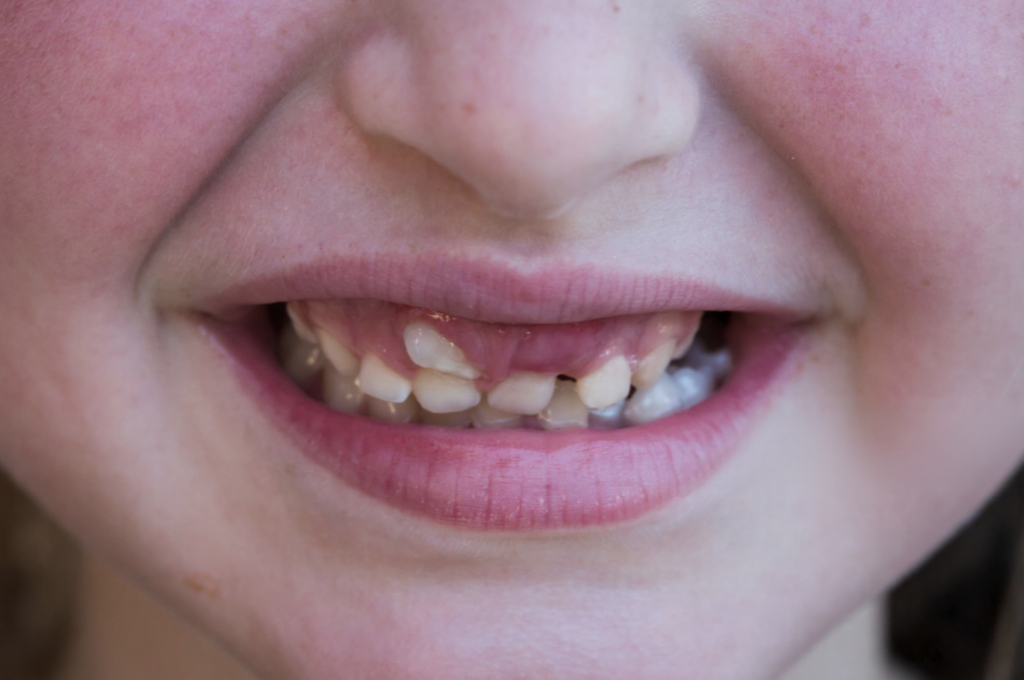
When your child smiles, and you spot a permanent tooth pushing through behind a baby tooth that hasn’t budged, the reaction is almost always the same: something must be wrong. At Miles of Little Smiles, we hear this concern regularly. The good news is that an adult tooth growing behind a baby tooth is one of the most common eruption patterns in early childhood. The better news is that most cases resolve without intervention. But some do need a closer look, and knowing the difference matters.
What Parents Are Actually Seeing When a Second Row Appears
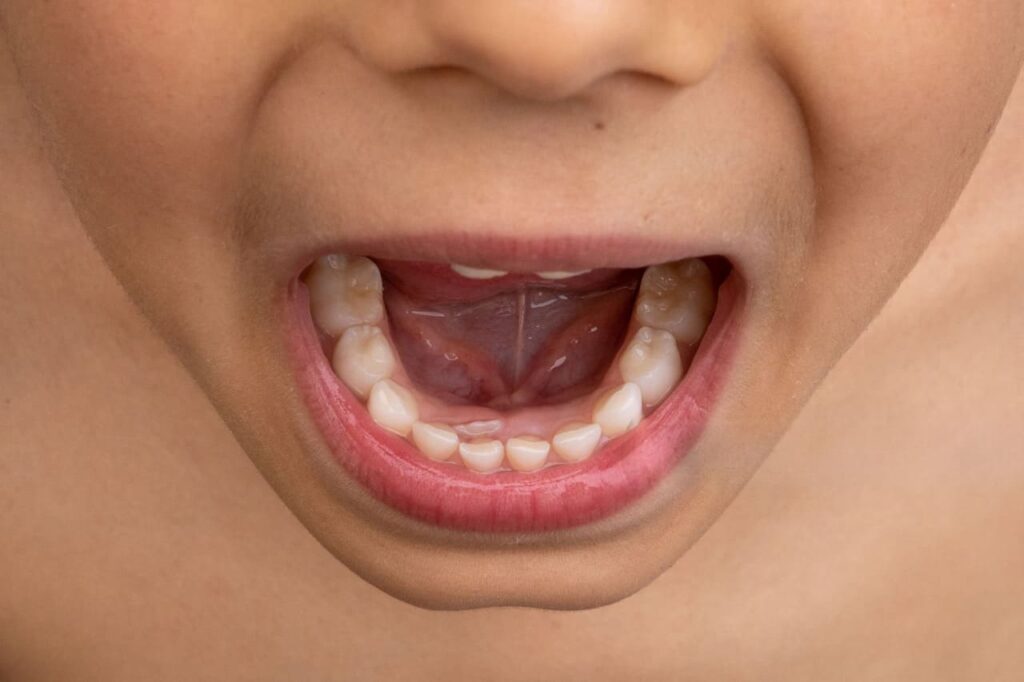
What you are seeing is called ectopic eruption, though most parents and even many general dentists refer to it as “shark teeth.” The permanent tooth has begun breaking through the gumline before the baby tooth in front of it has loosened or fallen out. This creates the appearance that your child has two rows of teeth, one sitting directly behind the other.
The permanent tooth is not growing in the wrong place. It is following a normal eruption path. The timing is simply off. The baby tooth root, which would ordinarily dissolve (a process called resorption) as the permanent tooth pushes upward, has not broken down quickly enough to clear the way.
Why This Happens Most Often in Lower Front Teeth
Shark teeth in kids appear most frequently with the lower central incisors, typically between ages five and seven. There are a few straightforward reasons for this:
- Lower incisors erupt first. These are usually the first permanent teeth to arrive, so any mismatch in timing shows up here before anywhere else.
- Space is tighter in the lower jaw. The permanent incisors are significantly wider than the baby teeth they replace, leaving less room for a gradual transition.
- The eruption path sits slightly lingual. Permanent lower incisors tend to develop behind and below the baby teeth rather than directly beneath them, which means they can bypass the roots of the primary teeth entirely.
| Tooth Position | Typical Age of Eruption | Likelihood of Shark Teeth |
| Lower central incisors | 5–7 years | Most common |
| Lower lateral incisors | 6–8 years | Common |
| Upper central incisors | 6–8 years | Less common |
| Upper molars | 9–12 years | Occasional |
>>> Read more: https://www.mouthhealthy.org/all-topics-a-z/eruption-charts

The First Thing to Check Is Whether the Baby Tooth Is Truly Loosening
Before scheduling an appointment or worrying about extraction, check the baby tooth. Give it a gentle wiggle. You are looking for mobility, even slight rocking, as a positive sign. A baby tooth that is beginning to loosen is a baby tooth that is still on its way out.
If the baby tooth moves when pressed with a finger, resorption of the root is already underway. The permanent tooth behind it is doing exactly what it should, just on a slightly delayed schedule.
If the baby tooth feels completely solid with no movement at all, that is a different situation and one worth monitoring more closely.
When Wiggle-and-Watch Is Reasonable for a Short Window
In many cases, the best course of action is patience. A watch-and-wait approach is appropriate when:
- The baby tooth has noticeable looseness, even if minor.
- The permanent tooth has only recently become visible behind it.
- The child is within the expected age range for that tooth’s transition.
- There is no visible redness, swelling, or sign of infection around either tooth.
Most pediatric dentists recommend giving the wiggle-and-watch for about two to four weeks. During that time, encourage your child to wiggle the baby tooth gently with their tongue or a clean finger several times a day. In a large percentage of cases, the baby tooth falls out on its own, and the permanent tooth drifts forward into position.
When a Retained Baby Tooth Is Unlikely to Move Fast Enough on Its Own
There are situations where waiting becomes less productive. A retained baby tooth is unlikely to resolve on its own when:
- It has shown zero looseness after two or more weeks of the permanent tooth being visible.
- The child is significantly past the typical eruption age for that tooth.
- The permanent tooth has erupted more than halfway, while the baby tooth remains firmly anchored.
- The child reports discomfort, difficulty eating, or sensitivity around the area.
At this stage, a pediatric dental evaluation gives you a clear picture of what the root looks like beneath the surface. An X-ray can show whether the baby tooth root is resorbing slowly, partially, or not at all.
>>> Read more: https://milesoflittlesmiles.com/child-dental-x-ray-white-plains/
Signs the Issue Is Shifting Into Crowding or Bite Management
Sometimes, a retained baby tooth is not just a timing issue. It can signal a broader space or alignment concern. Watch for these indicators:
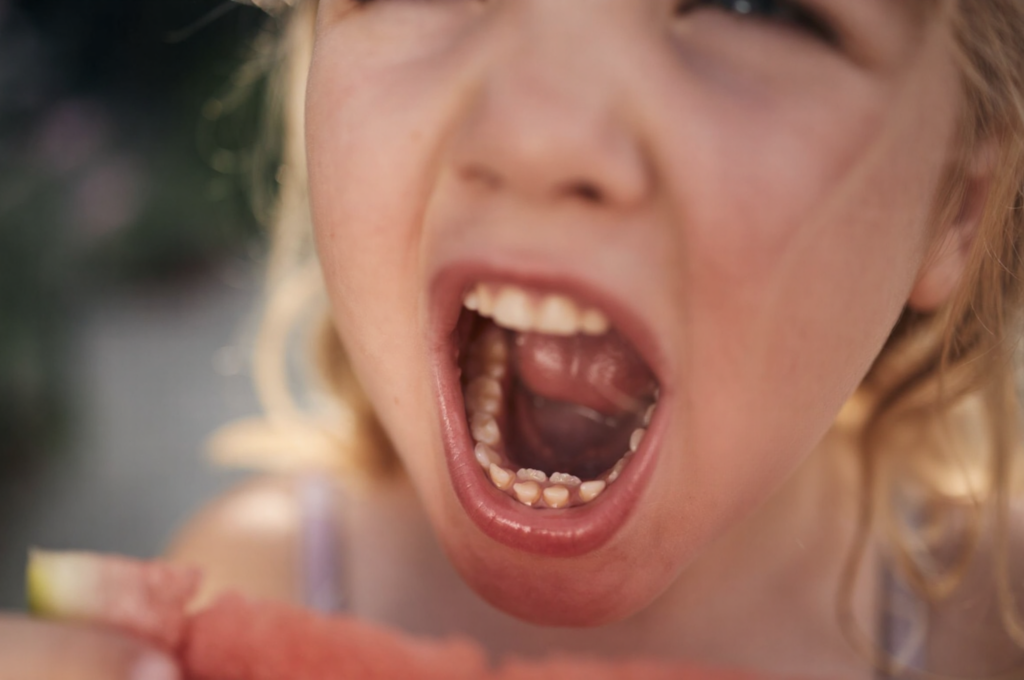
- Multiple permanent teeth erupt behind baby teeth at the same time.
- The permanent tooth appears to be angling sideways or rotating as it comes in.
- Neighboring teeth are beginning to shift or crowd together.
- The child’s bite feels different to them, or you can see that the upper and lower teeth are meeting in a new way.
| Scenario | Likely Concern | Recommended Action |
| Single shark tooth, baby tooth loosening | Normal eruption variation | Watch for 2–4 weeks |
| Single shark tooth, baby tooth firm after 2+ weeks | Retained baby tooth with incomplete resorption | Schedule an evaluation |
| Multiple shark teeth at once | Possible arch space deficiency | Schedule an evaluation |
| A permanent tooth erupting at an angle | Crowding or positional issue | Schedule an evaluation promptly |
When the issue moves beyond a single tooth, the conversation shifts from “will this baby tooth fall out?” to “is there enough room for everything to align properly?” That is a conversation best had with a pediatric dentist who can assess the full arch.
What a Pediatric Dentist Checks Before Recommending Extraction
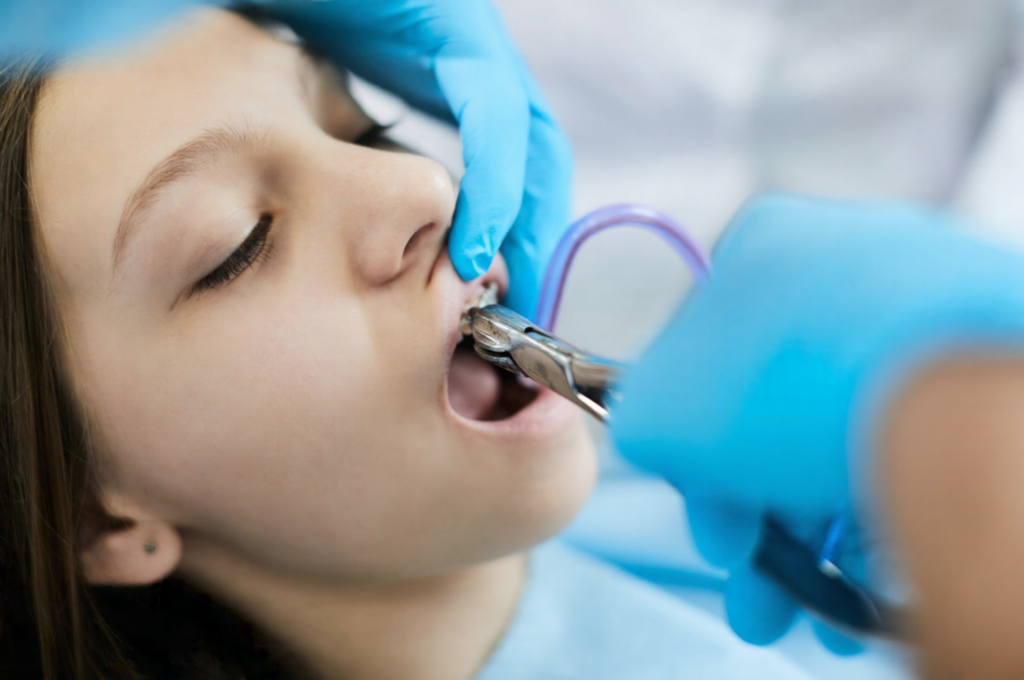
At Miles of Little Smiles, the decision to extract a baby tooth is never automatic. Before recommending baby tooth extraction for retained teeth, a pediatric dentist evaluates several factors:
- Root resorption status
A periapical X-ray shows how much of the baby tooth root remains. A root that is more than halfway dissolved may still finish the job on its own.
- Position and angulation of the permanent tooth
If the permanent tooth is erupting along a reasonable trajectory, time may still be an ally.
- Available space in the arch
The dentist measures whether the jaw has adequate room for the incoming tooth to settle into alignment.
- Age and dental development stage
A child who is early in the mixed dentition phase has more flexibility than one who is nearly finished with the transition.
- Soft tissue health
Inflamed or irritated gum tissue around the retained tooth can influence timing.
Extraction, when recommended, is typically a straightforward procedure. A retained baby tooth with a partially dissolved root often requires only local anesthetic and gentle elevation. Recovery is usually quick, and the permanent tooth begins migrating forward within a few weeks.
>>> Read more: https://milesoflittlesmiles.com/extractions/
What to Avoid Doing at Home
While it is fine to encourage gentle wiggling, there are a few things parents should avoid:
- Do not tie a string around the tooth or use pliers. Forced removal can fracture the root, damage surrounding tissue, or harm the incoming permanent tooth.
- Do not ignore a firm baby tooth for months. Waiting too long can allow the permanent tooth to settle into the wrong position, making orthodontic correction more likely later.
- Do not assume the problem is cosmetic. While two rows of teeth may look alarming, the real concern is whether the eruption path remains viable. That is a clinical question, not a visual one.
- Do not apply topical numbing agents and attempt extraction yourself. Even a very loose baby tooth can have a remaining root fragment that belongs in a clinical setting.
Book an Evaluation at Miles of Little Smiles
If your child has a permanent tooth behind a baby tooth and you are unsure whether this is a watch-and-wiggle case or a retained tooth that needs help, we are here to answer that question. A pediatric dental evaluation at Miles of Little Smiles gives you a clear understanding of whether the baby tooth is on a realistic path to falling out or whether a gentle assist will keep your child’s smile on track.
Schedule your child’s evaluation today and find out whether that second row of teeth is just a phase or something that needs a little guidance.
